
If your parts will be molded in Mexico, the resin almost always comes into the country as a temporary import under the molder’s IMMEX program. It enters duty-deferred, gets molded, and leaves again inside the finished parts. Who buys the resin — the molder or you — is a separate decision, and both models work.
What trips programs up is rarely the import itself. It is the details around it: scrap and regrind that never get exported, resin origin that can affect whether the finished part qualifies under USMCA, and lot paperwork that has to follow the material from the resin maker to your receiving dock.
Molder-supplied or consigned resin
There are two common ways to get resin to the press. In the molder-supplied model, the molder buys the resin, holds the inventory and builds it into the piece price. In the consigned model, you buy the resin — often on an existing corporate contract — and ship it to the molder, who charges for conversion.
Molder-supplied is simpler for you: one price per part and one party responsible for having material on hand. Consigned makes sense when you already have strong resin pricing, when the grade is specified so tightly that you want to control the source, or when you run the same resin at several plants and want one supply chain behind all of them.
- Consigned, the upside: your pricing and supplier relationship, direct control of grade and lot, one approved source across plants
- Consigned, the downside: you own the inventory and its carrying cost, you manage freight to the border, and a late truck stops your own job
- Consigned paperwork: material shipped at no charge still needs a commercial invoice with a customs value. No charge is not no value.
- Either model: agree in writing who owns scrap, who absorbs material lost to startup and changeover, and how yield is measured
How resin moves under IMMEX
IMMEX lets a Mexican manufacturer bring in materials for export production as temporary imports, with import duties deferred. For a molding program that covers more than resin. Colorants and masterbatch, metal inserts, packaging and the mold itself can all come in the same way. Our IMMEX explainer covers the permit; this is what it means for material.
The trade-off for deferral is accountability. Temporary imports have to leave Mexico, normally inside finished parts, within the timeframes the program sets, and the permit holder has to be able to show where every kilogram went. That runs through an inventory control system, commonly called Annex 24, that ties each import to the exports it was consumed in, using the bill of materials and actual yields.
In practice your part number needs an accurate material consumption: resin weight per part, colorant ratio, runner and sprue weight if the tool isn’t hot-runner, and expected startup scrap. If those figures are wrong, inventory doesn’t reconcile, and that becomes the molder’s problem with customs before it becomes yours. Give the molder real part and runner weights early. They are customs data, not just a costing input.
Scrap, regrind and material that never leaves
Not every kilogram of resin ends up in a shipped part. Purges, rejects, runners and regrind all have to be accounted for, because a temporary import that doesn’t get exported doesn’t stay duty-deferred indefinitely.
Regrind that goes back into production and ships inside finished parts is exported with them, as long as the consumption records show it. Material that doesn’t — purge, contaminated regrind, scrap parts, leftover resin at the end of a program — has to be regularized. Depending on the program and the material, that can mean returning it, documenting its destruction, or changing it to a definitive import and paying the duties. Which route applies and how it is documented is a question for your customs broker, and it is worth asking before the first lot, not at the end of the program.
If the resin is consigned, also agree what happens to your leftover material when a program ends or a grade changes. Shipping it back, moving it to another program and nationalizing it each carry different paperwork and different costs.
Where the resin comes from, and why it matters for USMCA
There are three common sources, and each trades cost against lead time and risk differently.
Origin is the part that surprises people. Whether the finished part qualifies for USMCA treatment depends on the rule of origin for its tariff classification. For some molded parts, the change in classification from resin to finished article is enough, and non-originating resin may not affect origin. For others a regional value content requirement applies, and resin from outside North America counts against you. USMCA also limits duty deferral on non-originating materials used in goods exported to the U.S. or Canada, so a program running Asian resin through IMMEX can carry a Mexican duty obligation that North American resin would not. None of this picks the resin for you. It is a reason to have a customs specialist check the part’s classification and rule before you pick one.
- U.S.-sourced resin trucked in: short, predictable overland transit and your existing U.S. contracts, and it may help the finished part’s origin. You pay for freight and a border crossing on every load.
- Mexican distributors: local stock and quick replenishment on common grades. Less choice on specialty grades, and the origin depends on the product, not the distributor.
- Asian resin: sometimes cheaper at the source, but ocean transit, port handling and slower replenishment mean more safety stock, and non-North-American origin can complicate USMCA qualification.
Paperwork that follows every lot
Every lot of resin should arrive with a certificate of analysis from the resin manufacturer, tied to a lot number that appears on the packaging and in the receiving record. The CoA is how you know the material matches the grade on the drawing. The lot number is how you trace a field problem back to a specific shipment.
Good traceability runs in both directions: from a resin lot to every production lot it went into, and from a finished part back to the resin, colorant and inserts it was made from. It is largely the same data IMMEX inventory control needs, so a plant that tracks one well usually tracks the other. Before the first lot, work through this list:
- Decide molder-supplied or consigned, and write it into the quote
- Name the exact resin grade, the approved sources and the rules for substitution
- Confirm part weight, runner weight and expected startup scrap for the consumption records
- Have a customs specialist check the finished part’s classification and USMCA rule of origin, including where the resin comes from
- Agree scrap ownership, regrind rules and how unexported material gets regularized
- Require a CoA and lot number with every shipment, and define traceability through to finished goods
- For consigned material, agree commercial-invoice values, transit to the border and the minimum stock held at the plant
How it works at USMEX
USMEX operates under its own IMMEX permit, so resin, components and tooling for your program enter Mexico as duty-deferred temporary imports for export production, and finished parts cross overland to the U.S. in hours. For companies that want their own operation in Mexico, there is also a shelter program.
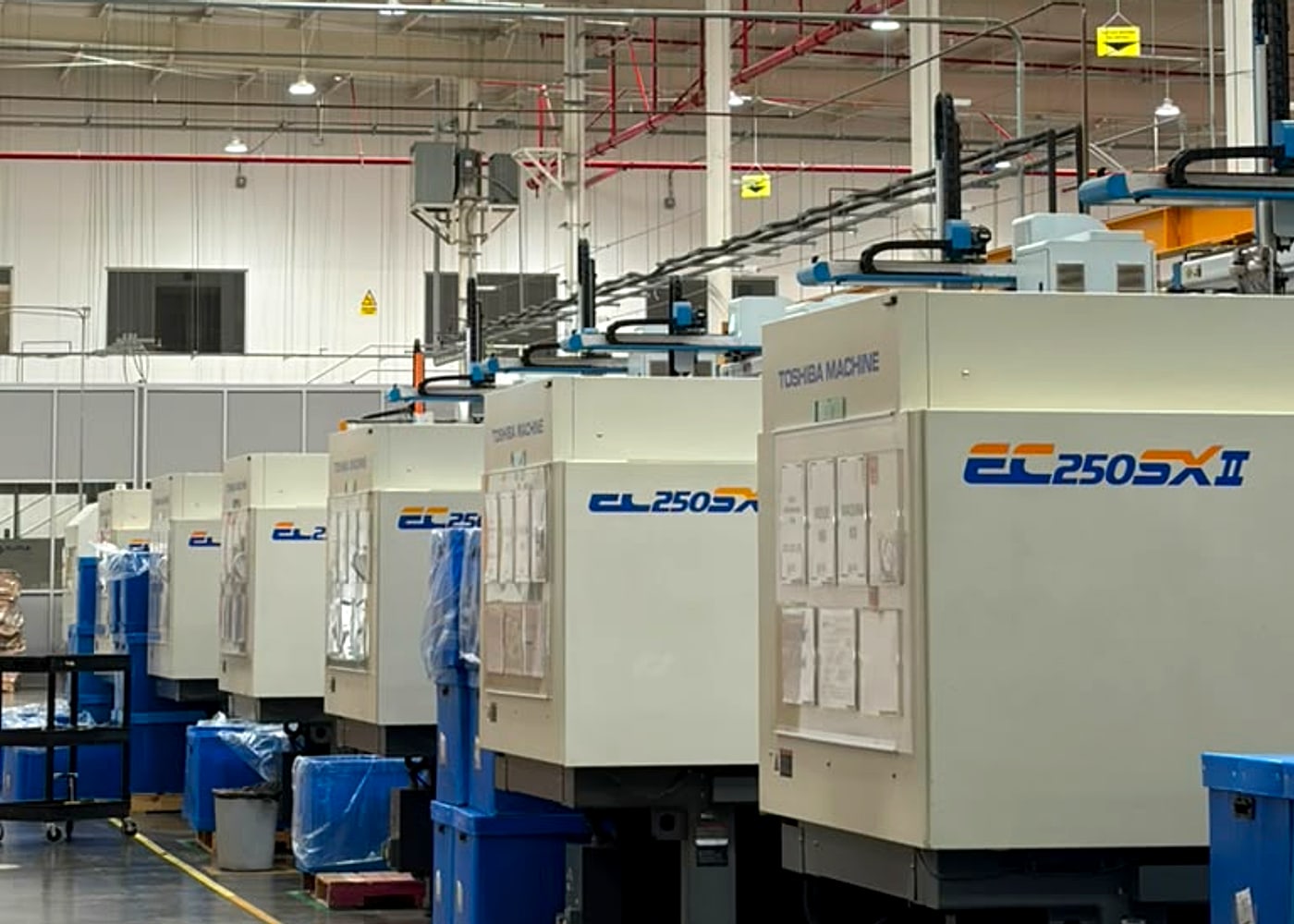
The Tijuana plant runs ten 250-tonne injection presses — seven all-electric Toshibas and three Haitian hydraulics — with an on-site machine shop, plus extrusion, plating and assembly in-house. Every program starts with an NDA and a manufacturability review that covers resin, gate and cooling, cycle and the quality plan. Send drawings or 3D files and the grade you use today, and we’ll start there.
Quick answers
Do I pay import duty on resin brought into Mexico under IMMEX?
Not up front. Under IMMEX, resin used for export production enters as a temporary import with duties deferred, as long as it leaves Mexico inside finished parts within the program’s timeframes and the inventory records show it. Material that isn’t exported has to be regularized, which can mean paying duties.
Can I consign my own resin to a molder in Mexico?
Yes, it is a common model. The molder imports it under its IMMEX program and you keep control of grade and source. Plan for your own freight to the border, a commercial invoice with a customs value, and clear rules on scrap and leftover material.
Does the resin’s origin affect USMCA qualification of the molded part?
It can. It depends on the rule of origin for the finished part’s classification: some rules are met by the change from resin to molded part, others include a regional value content requirement. Have a customs specialist check before choosing a source.
What happens to scrap and regrind in an IMMEX resin temporary import?
Regrind that goes back into shipped parts is exported with them. Purge, rejects and leftover material generally have to be returned, documented as destroyed, or imported definitively with duties paid. Confirm the process with your customs broker.
What paperwork should come with each resin lot?
A certificate of analysis from the resin manufacturer and a lot number that matches the packaging and the receiving record, so every production lot can be traced back to the resin it used.