
Glass filled nylon injection molding trades toughness and surface finish for stiffness, strength and heat resistance. Adding short glass fiber to nylon or ABS makes the part stiffer, stronger, more dimensionally stable and able to hold its shape at higher temperatures — and it makes the resin more abrasive, more sensitive to where the gate is, and more likely to warp if the part isn’t designed for it.
None of that is a reason to avoid reinforced resins. It is a reason to specify them carefully. The exact grade, the gate location, the drying, the tool steel and the regrind rules all have to be settled before the first shot, not after the first warped part.
What the glass buys you, and what it costs
Glass fiber carries load the polymer can’t. In a well-molded part that shows up as higher tensile strength and flexural modulus, less creep under sustained load, lower thermal expansion and a higher heat deflection temperature. The heat gain is largest in semicrystalline resins like nylon. In an amorphous resin like ABS, stiffness improves but heat behaviour changes less.
The costs come in the same package. Reinforced grades are less ductile, so impact strength and elongation drop, and a snap fit that worked in unfilled material may crack. Fibers near the surface show as a dull, streaky finish. Shrinkage becomes different along the flow than across it, which is the root of most warp. The melt is stiffer, so injection pressures go up. And glass is abrasive: it wears gates, cavities, vents, screws and check rings faster than unfilled resin.
Glass filled ABS deserves its own word. Most people pick ABS for toughness and a good cosmetic surface, and glass takes away some of both. It makes sense for stiff housings and brackets that need ABS’s processing and bonding behaviour. If impact is the reason you chose ABS, test the reinforced grade before you commit to it.
- Gains: stiffness, strength, creep resistance, heat deflection, dimensional stability
- Part costs: lower impact and elongation, fiber show on the surface, warp from uneven shrinkage
- Process costs: higher injection pressure, faster wear on the tool and on the press
Fiber orientation decides where the part is strong
Fibers line up with the flow. Near the surface they mostly follow the flow direction; in the core they can turn across it. The result is a part that is stronger and shrinks less along the flow than across it. Where the flow direction changes, the part pulls unevenly and warps.
That makes gate location a structural decision, not just a cosmetic one. Put the gate where the flow will run along the main load path. Keep weld lines away from high-stress features, because fibers don’t bridge a weld line and its strength can fall well below that of the surrounding material. On long or flat parts, a gate at one end usually gives more uniform orientation than a gate in the middle that splits the flow two ways.
A mold-flow simulation earns its cost on reinforced parts. It predicts orientation, weld lines and warp before the steel is cut, which is when moving a gate is still cheap.
Drying: required for nylon, expected for ABS
Nylon is hygroscopic. It pulls moisture from the air, and wet nylon degrades in the barrel: the water breaks down the polymer, which shows up as splay on the surface or, worse, as parts that look fine and are brittle. Dry it to the moisture level and conditions on the resin supplier’s datasheet, keep it dry between the dryer and the feed throat, and check it rather than trusting the clock. Over-drying causes its own problem, usually discoloration, so follow the datasheet, not habit.
ABS absorbs less, but still enough to cause splay and cosmetic defects, so it is normally dried too, again per the datasheet.
The subtler nylon issue happens after molding. A part comes off the press dry-as-molded, which is when it is stiffest and most brittle. Over time it absorbs moisture from the air, becomes tougher and less stiff, and grows slightly. Glass reduces that change but doesn’t remove it. Agree up front whether dimensions and mechanical tests are taken dry-as-molded or after conditioning, and write it on the drawing or the quality plan. A lot of arguments about nylon parts being out of tolerance start right here.
The tool and the process: steel, mold temperature, regrind
A tool for glass fiber reinforced plastic molding should be built for wear. That usually means hardened tool steel in the cavities, or at least wear-resistant, replaceable inserts at the gates and other high-velocity spots, because that is where fiber erodes steel first. A gate that has worn open changes fill, and changed fill changes the part. Design gate inserts to be swapped and put gate inspection on the preventive maintenance schedule. The press wears too: screws, barrels and check rings see more abrasion over a long run.
Mold temperature is the main lever on appearance. A hotter mold lets a resin-rich skin form over the fibers, which hides fiber show and evens out the surface; fill speed matters as well. The price is cycle time. If appearance is critical, a texture on the cosmetic faces often does more than chasing gloss in a glass-filled grade.
Regrind is where reinforced resins differ most from unfilled ones. Every pass through the screw breaks fibers shorter, and shorter fibers mean less stiffness and strength. Some programs allow a limited share of regrind blended with virgin resin; some safety-critical and medical specifications allow none. Treat that as a customer decision written into the spec, not a molder’s default, and if regrind is allowed, ask how it is segregated and tracked.
Designing and specifying a reinforced part
Most of the usual rules of plastic part design matter more with glass in the resin.
Then specify the grade exactly. “Nylon, glass filled” is not a specification. Grades are named by base resin and loading — PA66 with 30% glass, for example — but two suppliers’ versions of the same description can mold and perform differently, and heat-stabilized, impact-modified, lubricated and flame-retardant variants all exist. Name the manufacturer and grade, say whether substitutes are allowed and how they get approved, and attach the resin supplier’s datasheet so the molder is working from the same numbers you designed with.
- Keep wall thickness uniform. Thick-to-thin transitions change orientation and cooling at the same time, which invites warp and sink.
- Orient ribs on purpose. Ribs that run with the flow fill cleanly and put fiber along the load; ribs across the flow are more prone to short shots and weak spots.
- Radius every inside corner. Reinforced resins are notch-sensitive, and a sharp corner is a crack starter.
- Give it draft. One to two degrees per side is a common starting point, with more on textured faces.
- Tolerance for anisotropy. Ask the resin supplier for shrinkage both along and across the flow, not a single number.
- Design snap fits for lower elongation, or switch to screws or heat-set inserts.
What USMEX runs
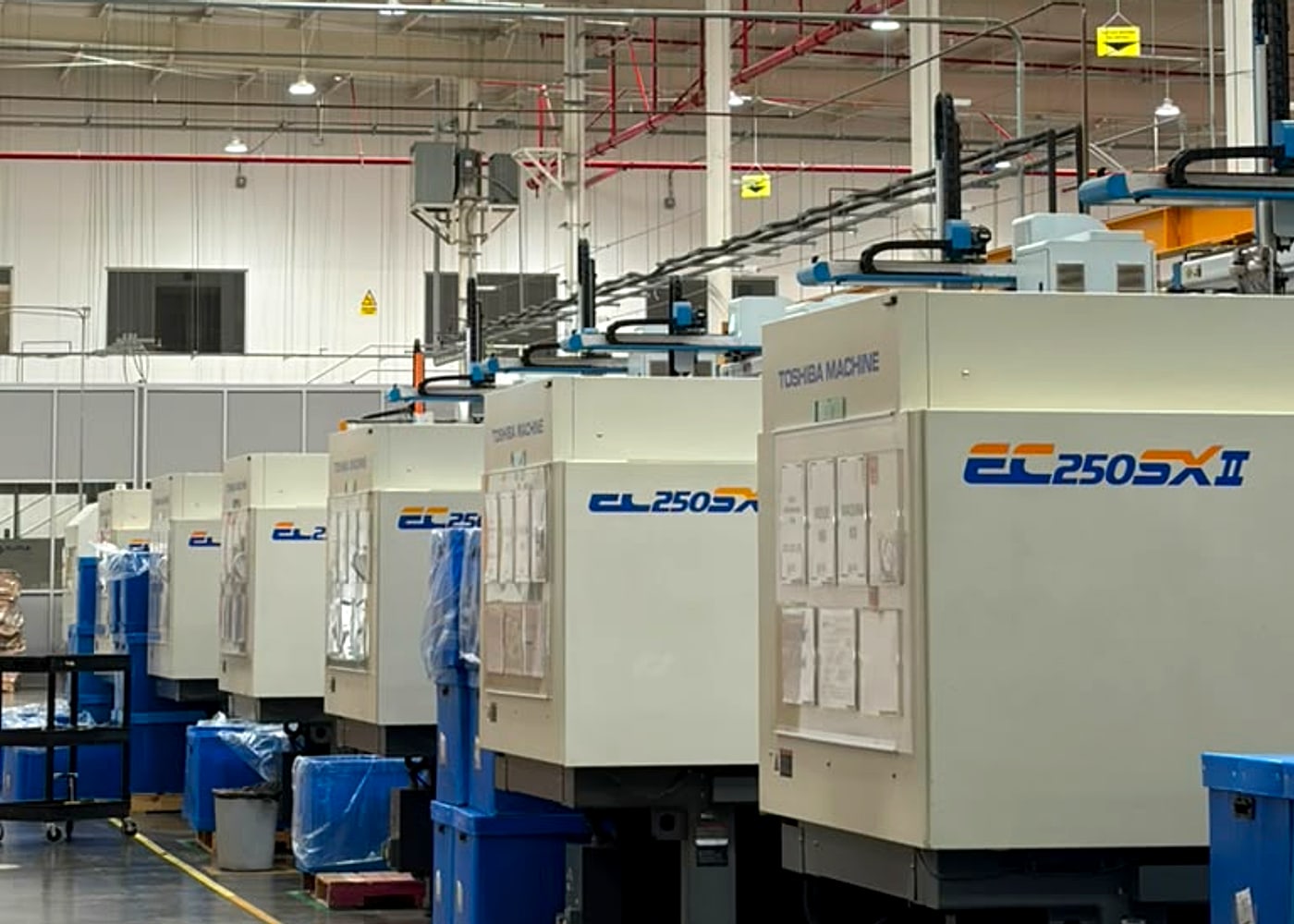
Our Tijuana plant runs ten injection presses, all 250-tonne clamp: seven all-electric Toshibas and three Haitian hydraulics. Because the whole fleet is one clamp class, a tool qualified on one press can run on the others. The on-site machine shop handles mold preventive maintenance and repair, so gate wear on a reinforced-resin tool gets dealt with here instead of crossing the border.
Every program starts with an NDA and a manufacturability review covering resin, gate and cooling, cycle and the quality plan, followed by first-article inspection and in-process QC to your plan. If you are specifying a glass-filled nylon or ABS part, send the drawing or 3D file and the grade you have in mind, and we’ll start there.
Quick answers
Is glass filled nylon harder to injection mold than unfilled nylon?
Somewhat. It needs proper drying, higher injection pressure and a tool built for wear, and it is more sensitive to gate location because fiber orientation drives shrinkage and warp. None of that is unusual when it is planned for before the tool is built.
Does glass filled ABS lose impact strength?
Generally, yes. Glass makes ABS stiffer and more dimensionally stable but less tough. If impact resistance is why you chose ABS, test the reinforced grade before committing to it.
Why do glass filled nylon parts warp?
Mostly because the fibers align with the flow and the part shrinks differently along the flow than across it. Gate location, uniform walls, mold temperature and cooling are the main controls, and a mold-flow study helps predict warp before the steel is cut.
Can regrind be used in glass fiber reinforced plastic molding?
Sometimes, within limits the customer sets. Regrinding shortens the fibers and reduces properties, so many specifications cap the regrind share and some prohibit it.
Should nylon parts be measured dry or conditioned?
Either can be right, but it has to be agreed and written down. Nylon absorbs moisture after molding and its dimensions and toughness change as it does, so the measurement condition belongs on the drawing or the quality plan.