
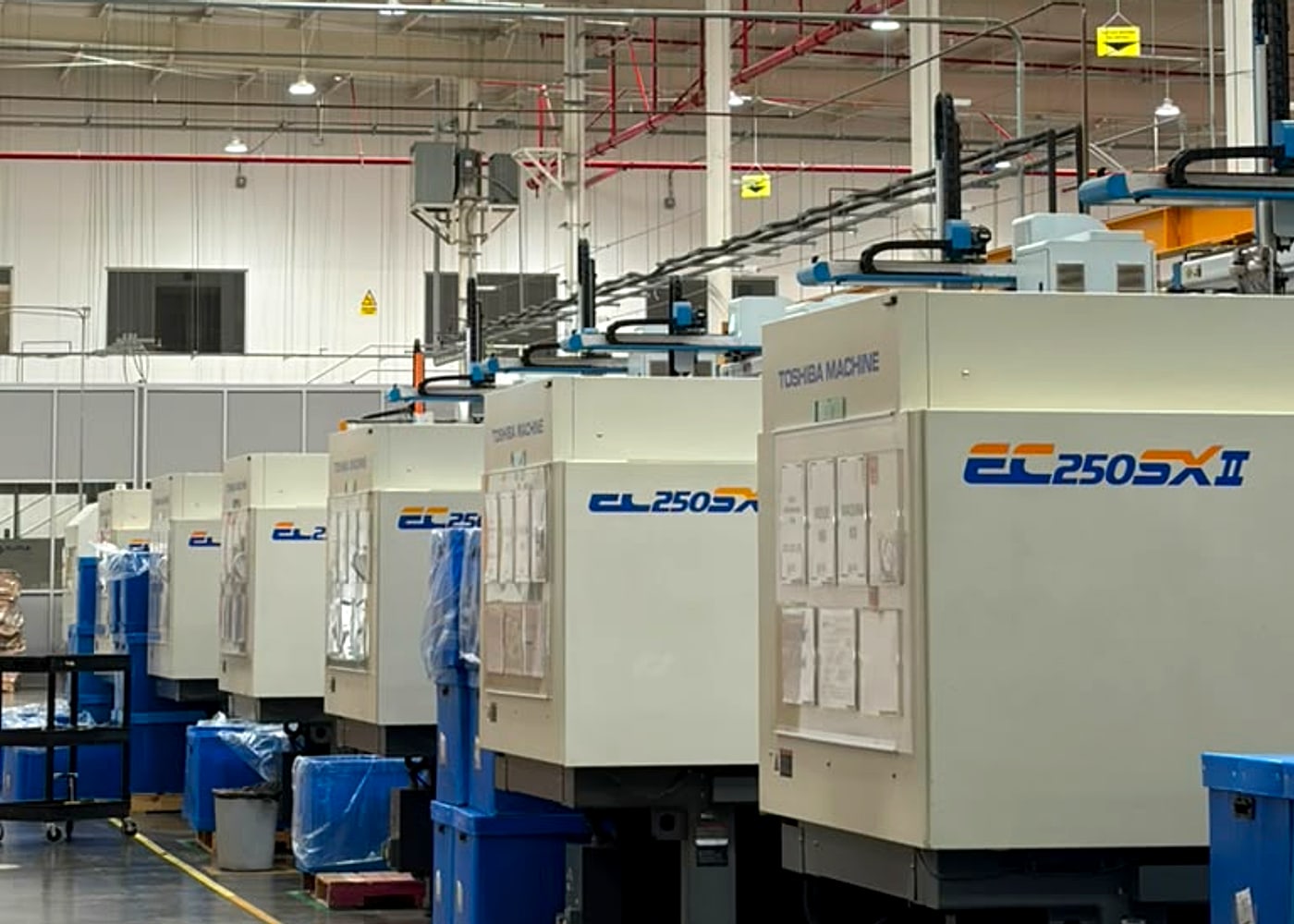
For most parts, whether the press is all-electric or hydraulic matters less than whether it has the right clamp force and the right hookups for the tool. Where it does matter, the split is fairly clean: an electric injection molding machine repeats more tightly shot to shot, uses less energy and keeps oil away from the mold; a hydraulic press is simpler, tougher, cheaper to buy and drives the hydraulic core pulls some tools depend on.
So the useful question isn’t which technology is better. It is which one your part and your tool need, and whether your molder has that press in the right size.
How each machine moves
An injection molding machine does four jobs that take force: it closes and clamps the mold, turns the screw to melt resin, drives the screw forward to inject and pack, and ejects the part. A hydraulic press does all of this with oil. An electric motor drives a pump, the pump pressurizes hydraulic oil, and valves route that oil to cylinders for the clamp, injection, ejection and any core pulls. Many newer hydraulics drive the pump with a servo motor so it slows down when nothing is moving.
An all-electric press takes the oil out of the main drives. Each axis — clamp, injection, screw rotation, ejection — has its own servo motor, typically turning a ball screw or driving a toggle through one. Position and speed are set directly by the motor instead of by oil flowing through a valve.
Hybrids sit in between. Some pair an electric screw drive with hydraulic clamping or injection, and many electric presses can be fitted with a small hydraulic unit for core pulls. If a hybrid or an add-on unit is part of a molder’s answer, ask exactly which functions it covers.
Where all-electric wins
Repeatability is the main reason to choose one. A servo motor moving a ball screw hits the same position at the same speed every shot, and it doesn’t drift as oil warms up over a shift or as its viscosity changes. For parts where fill and pack have to be the same from the first shot of the day to the last — thin walls, small precise features, optical and medical components — that consistency shows up in the dimensional data.
- Energy: motors draw power when they move, not while a pump idles, and there is no oil to cool. How much that saves depends on the part, the cycle and the hydraulic press you compare against.
- Cleanliness: no hydraulic oil circuit around the mold area, so no oil mist or leaks near the part. The ball screws are still greased, so it is less oil, not no lubricant.
- Noise and heat: quieter running, and less heat going into the building and the cooling water.
- Overlapping motions: independent drives make it easier to run some movements at the same time, such as screw recovery while the mold opens.
Where hydraulics win
Hydraulic presses have been the industry’s workhorse for a long time, for good reasons. Oil pressure holds clamp and pack force naturally, without a motor working to hold a position. The machines tolerate hard use, they are generally less expensive to buy at a given clamp size, and their maintenance — pumps, valves, seals, oil — is familiar to almost any molding technician.
For a buyer, the biggest practical advantage is core pulls. A tool built with hydraulic cylinders — for a long side core, a heavy slide that angle pins can’t drive, or a sequenced action — connects to the press’s core-pull circuits, and the press controls the sequence. Heavy shots, thick walls with long pack and hold, and jobs that need sustained injection pressure also tend to sit comfortably on a hydraulic.
Takeaway: if the tool was built with hydraulic cores, or the part is thick and forgiving on repeatability, a hydraulic press is the natural fit.
What it means for your part
Start with the tool, not the press. Look at the tool drawing for hydraulic cylinders. Mechanical slides driven by angle pins don’t care what drives the press. Hydraulic cores need hydraulic circuits and sequencing on the press, or an external hydraulic power unit with an interface to the press controller. That one detail can decide which machines a tool can run on.
Then match the rest:
- Clamp force from the projected area of part and runner and from the resin, not from what the last supplier happened to use
- Shot size against part plus runner, so the barrel is neither starved nor badly oversized
- Repeatability: which dimensions are critical to function, and how tight they are
- Cleanliness: medical, optical or cosmetic parts that can’t tolerate oil contamination
- Cycle: cooling usually sets it, and cooling depends on wall thickness and resin more than on the press
Why both types in one clamp class helps
Most plants build their fleet one purchase at a time, so their electric and hydraulic presses end up in different sizes. That turns the choice between technologies into a choice between clamp classes, and a tool that fits one press may not fit the other.
Our Tijuana plant runs ten injection presses, all 250-tonne clamp: seven all-electric Toshibas — six EC250SXII V50 and one EC250SXIII V70 — and three Haitian MA2500 hydraulics. Because the clamp class is the same across the fleet, the choice between electric and hydraulic is made on what the part and the tool need, and a tool qualified on one press can move to another of the same type when maintenance or a changeover takes a cell down. The machine shop on site handles tool maintenance and modifications, so adapting a tool doesn’t mean shipping it across the border.
Every program starts with an NDA and a manufacturability review — resin, gate and cooling, cycle and the quality plan — and part of that review is deciding which presses your tool will be qualified on. Send drawings or 3D files under NDA and we will tell you which press type we would run your part on, and why.
Quick answers
Is an all-electric injection molding machine better than a hydraulic one?
Not across the board. Electric presses repeat more tightly, use less energy and keep oil away from the mold. Hydraulics cost less to buy, are very robust and drive hydraulic core pulls natively. The right choice depends on the part and the tool.
Can a mold with hydraulic core pulls run on an electric press?
It can if the press has a hydraulic unit for cores, or if an external power unit is connected and sequenced with the press controller. Check this during the manufacturability review, before the tool ships.
Does press type change the part price?
It can, through cycle time, energy and scrap, but by how much depends on the part. Cycle time is mostly set by cooling, which depends on wall thickness and resin more than on the press.
Do medical parts have to run on electric presses?
Not by rule. Electric presses are common for medical and optical work because there is no hydraulic oil near the mold and the process repeats tightly. What a medical program actually requires depends on the device and its regulatory path, and if your part needs a certified quality system such as ISO 13485, ask the molder for the certificate.