
If you already mold in China, the tool you paid for is usually the single largest sunk cost in the program — and it is usually transferable. A mold built for one press can often run on another with modification to the clamping, ejection, water lines or sprue. That is the whole question worth answering first, because it decides whether moving production means re-spending the tooling budget or moving the tooling you already own.
Start with a mold compatibility study, not a quote
A mold compatibility study checks your existing tool against the target press: shut height, tie-bar spacing, platen dimensions and bolt pattern, ejector stroke and pattern, water circuit connections, and whether the sprue bushing and locating ring match. It is cheap and fast relative to anything else in the program, and it de-risks every decision after it.
Ask for it before you ask for a piece price. A per-part quote that assumes a tool will run is a guess; a quote written after the tool has been checked is a number both sides can hold to.
- Shut height and daylight against the press
- Tie-bar spacing and platen bolt pattern
- Ejector stroke, pattern and knockout compatibility
- Water circuits, sprue bushing and locating ring
- Steel condition, cavity count and expected remaining life
What usually needs work
Modification is normal and rarely fatal. Common items are a new locating ring, adapted clamp slots, re-plumbed water connections and an ejector plate adaptation. Less common but more serious: a tool built for a much larger platen, a hot-runner controller with no local support, or steel that is near the end of its life anyway.
The last of those is worth catching early. A tool with a few hundred thousand shots left is a different conversation from a tool with a few million, and it changes whether transfer or a new build is the better spend.
The tariff arithmetic is usually the reason, not the labour
Companies moving molding out of Asia rarely lead with labour cost. They lead with landed cost: duty plus ocean freight plus the working capital tied up in six to ten weeks of transit and the safety stock that transit forces you to hold. Goods made in Mexico that qualify under USMCA are treated very differently from goods entering from China under Section 301 — check your own part's classification and rate at the USTR link below rather than trusting a rule of thumb.
The practical test is simple: add duty and freight to what you pay your Chinese supplier, divide by units, and compare that to a delivered price from Tijuana. If duty and freight are a large share of your landed cost, the comparison is not close.
Order of operations
Programs that move smoothly tend to run in the same sequence, and skipping steps is what causes the restarts.
- NDA, so drawings and specs can actually be exchanged
- Mold compatibility study against the target presses
- Part-by-part tariff classification with a customs specialist
- Tool shipment, receipt inspection and any modification
- Mold trial (T1), first-article inspection, dimensional report
- Pilot run at low volume, then release to production
What USMEX runs
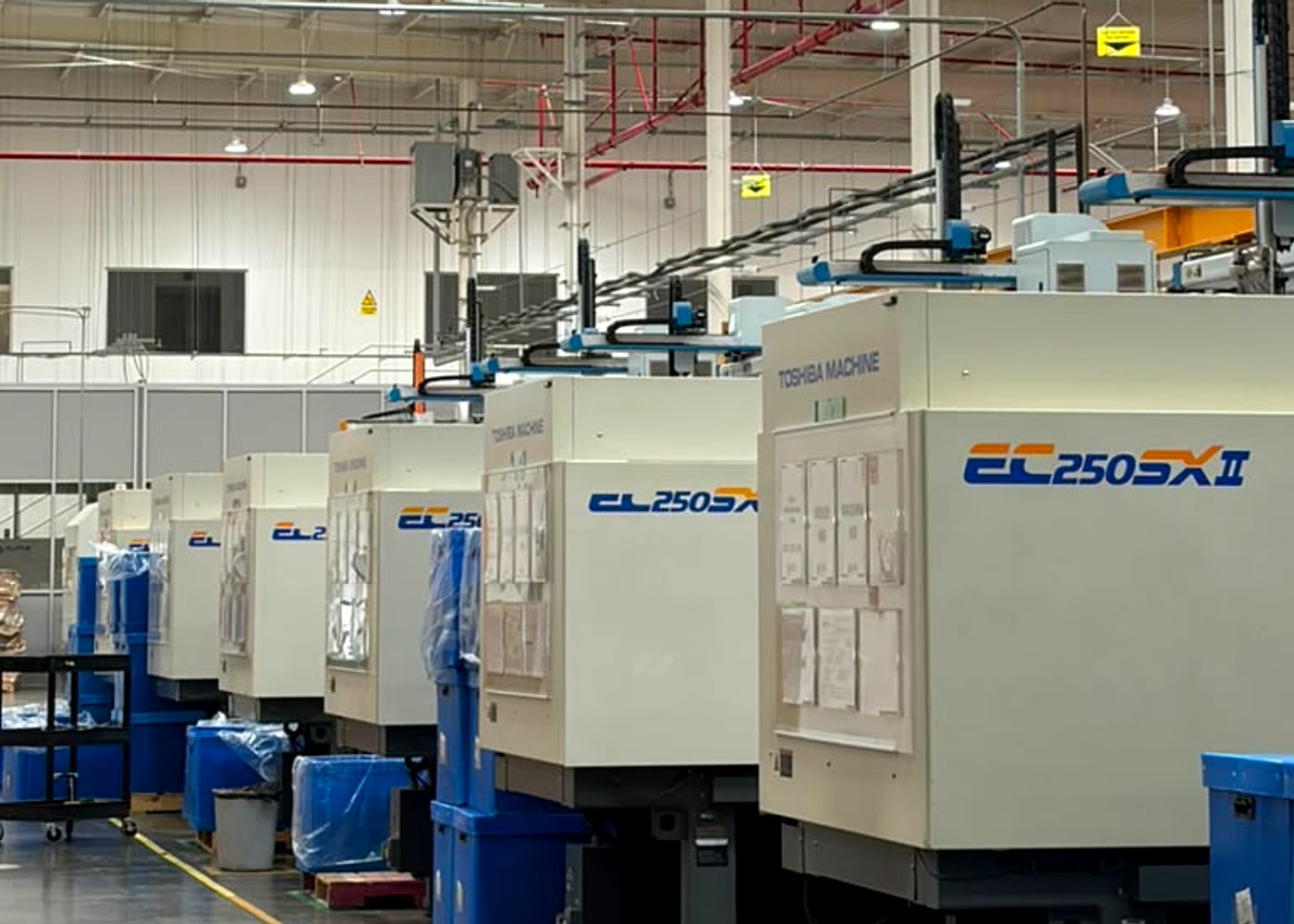
Our Tijuana plant runs ten injection presses, all 250 tonne — seven all-electric Toshibas and three Haitian hydraulics — with a machine shop on site, so a tool that needs modification does not leave the country to get it. Resin and tooling enter Mexico duty-free as temporary imports under our IMMEX permit, and finished parts cross overland to the U.S. in hours rather than ocean weeks.
One clamp force across the fleet means a tool qualified on one press runs on all ten, so maintenance or a long changeover moves your program to the next identical cell instead of stopping it.
Quick answers
Can my existing Chinese mold run in Mexico?
Often, with modification. A mold compatibility study checks shut height, tie-bar spacing, ejector pattern, water circuits and the sprue against the target press, and tells you what needs changing before anything ships.
What does a mold compatibility study need from me?
The tool drawing or 3D file, the resin and grade, the cavity count, and the press it currently runs on. An NDA usually comes first, which is normal.
How long does a molding transfer take?
It depends on the tool and the certifications involved, but the sequence is NDA, compatibility study, classification, shipment, T1 and first articles, then a pilot run before production. The compatibility study is the step that most changes the timeline, which is why it goes first.
Is the saving from cheap labour?
Usually not. For most parts the deciding numbers are duty and freight, plus the working capital tied up in ocean transit. Labour matters, but it is rarely the reason a program moves.