
Choosing among injection molding companies in Mexico comes down to one question asked several ways: can this plant run your tool, on more than one press, with the documents and customs paperwork your program needs, and fix problems without shipping anything back across the border? A press list answers part of it. The rest you get by asking specific questions and noticing who in the room can answer them.
If you ship to the U.S., weight location heavily: injection molding in Tijuana or another border city means parts are trucked across in hours. Location narrows the list. The checks below decide it.
Start with the press fleet, measured against your tool
Don't ask how many presses a molder has. Ask which presses your tool fits, and how many of those there are.
Clamp tonnage comes first. The clamp force a part needs depends on its projected area, wall thickness, flow length and resin, and a good molder calculates it from your 3D file instead of guessing from the part's size. Then check the physical fit: the mold has to pass between the tie bars, its shut height has to sit inside the press's minimum and maximum, and the locating ring, ejector pattern and platen bolt pattern have to match or be adaptable. Shot size matters too: the usual guidance is to keep the shot comfortably inside the barrel's capacity, away from either extreme.
The mix of all-electric and hydraulic machines tells you something as well. All-electric presses are generally more repeatable and cleaner to run, which matters for tight-tolerance, optical and medical work. Hydraulics are forgiving and often simpler for tools with hydraulic core pulls. A plant with both can put your part on the machine that suits it.
Last, redundancy. If your tool fits exactly one press in the building, a breakdown on that press stops your program. Several identical presses in the same clamp class means the job moves to the next cell. Count the presses your tool can actually run on, not the presses on the brochure.
Tool room, mold transfer and trials
Molds wear, break and need changes. A plant with its own tool room can weld, re-cut a gate or replace a worn insert the same week. A plant without one sends the tool out, sometimes across the border and back, with customs paperwork both ways. Ask to see the tool room, and ask what still goes to outside shops.
If you are moving an existing tool, ask how the molder handles its arrival: inspection on receipt, a written condition report before any trial, and a clear line between repairs the tool needed before the move and damage in transit or on their press. Then ask how trials work: who pays for trial resin and press time, how many rounds are included, and what comes back after each one. You want process settings, sample parts and a list of what to change. A molder that sends only parts, with no settings and no notes, will be hard to work with the first time something drifts in production.
Quality system and documentation
Ask what the plant's quality documentation looks like before you ask whether it is certified. First-article inspection means a full dimensional check of early parts against every characteristic on your drawing, recorded in a report you can audit. In-process inspection means parts are checked during the run against a plan you agreed to, and recorded. Lot traceability means that if a box of parts fails in the field, the molder can tell you which resin lot, press and shift made it.
Automotive buyers will know PPAP, the production part approval process: a package of dimensional results, material certifications, process flow, failure-mode analysis, control plan and capability studies that shows a process can make the part consistently before full production. Other industries often ask for a lighter version. Ask to see a real first-article package from another job, customer name removed. It tells you more than a certificate on the lobby wall.
Certification still matters when your part requires it. Medical device parts may need a supplier certified to ISO 13485 and able to work inside your FDA-regulated quality system; automotive tiers often require IATF 16949. If your program needs one, ask for the certificate and confirm its scope covers molding at the site that will make your part. Documents first, certificates second.
IMMEX status, importer of record and logistics
Ask whether the molder operates under its own IMMEX permit. IMMEX lets a Mexican manufacturer bring in resin, components and tooling as temporary imports for export production, with duties and import taxes deferred. Without it, those costs are paid up front and end up somewhere in your piece price. Some work under a shelter company's permit instead, which can work fine; just know whose permit your tool will sit under.
Then settle the importer of record on both sides. On the Mexican side, the permit holder normally imports your tool and materials temporarily. On the U.S. side, someone has to be importer of record for the finished parts, file the entry with CBP and pay any duty owed on the part's classification. That is usually you or your customs broker, but decide it in writing before the first truck. Also ask how your tool leaves Mexico if the program ends. A tool that came in as a temporary import leaves with its own export paperwork, and a molder that has done it before will explain how.
Secondary operations belong in the same conversation, because they are also about hand-offs. A plant that does assembly, plating or packaging under one roof removes a truck move and a second supplier's paperwork for every step it absorbs, and one more place for parts to be damaged or held at a dock.
Communication, NDA and the plant visit
A shortlist should end with a visit. Before it, sign a mutual NDA so the molder can see your drawings and 3D files and talk concretely about your part. A molder who wants to quote before seeing data, or who shrugs at an NDA, is showing you how the rest of the program will go.
Pay attention to who talks to you. You want bilingual engineers, not only a bilingual salesperson, because the conversations that matter happen between your engineer and the person who sets the process, usually when something has gone wrong. Questions worth asking on the floor:
- Which presses does my tool fit, how many identical ones do you have, and where does my job go when one is down?
- Can I see a first-article report and a control plan from another program?
- How do you trace a part back to its resin lot, press and shift?
- Whose IMMEX permit will my tool and resin come in under, and who is importer of record on the U.S. side?
- Which secondary operations happen in this building, and which are subcontracted?
- Who will my engineer talk to, and in what language?
What USMEX runs
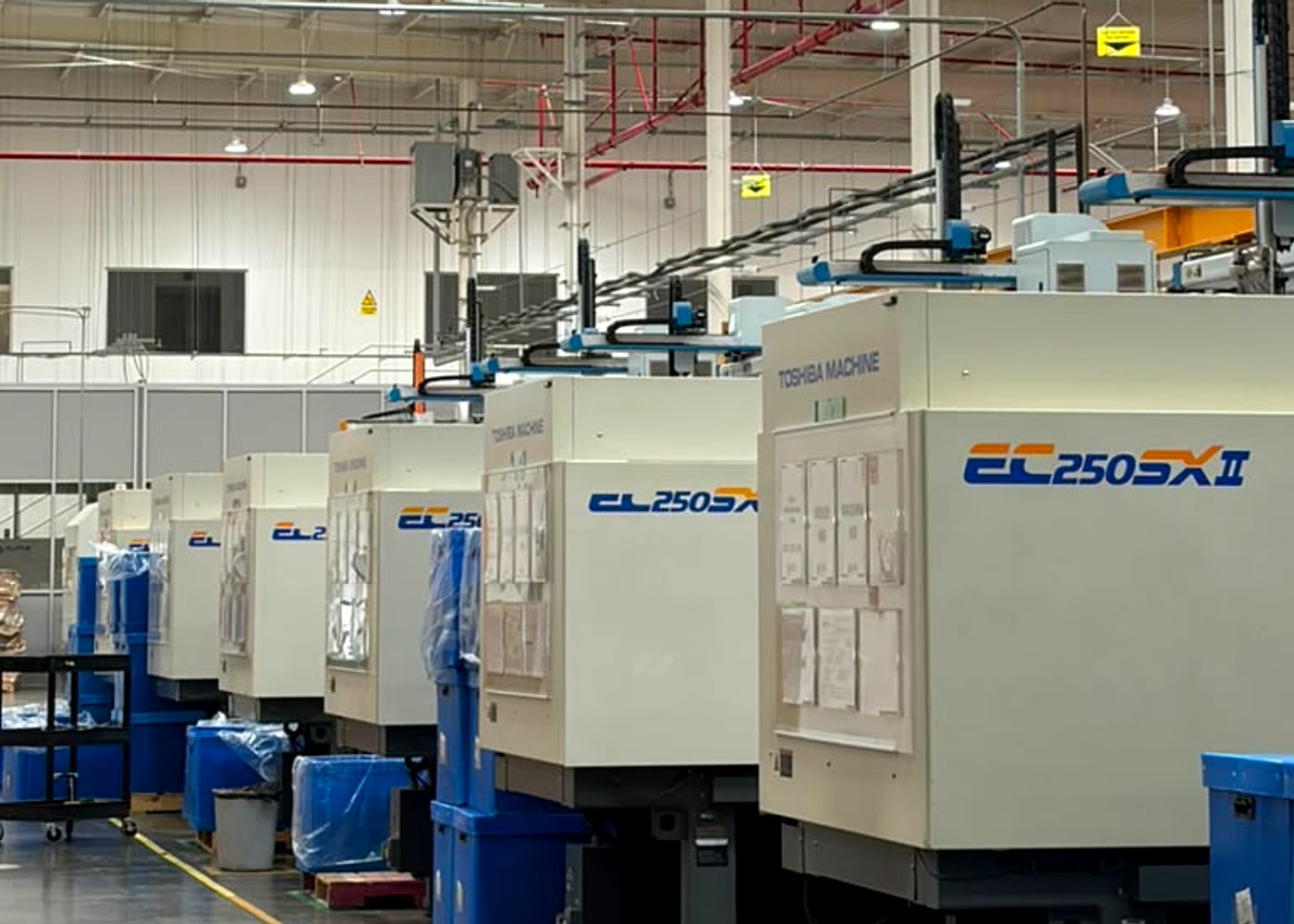
USMEX runs injection molding in Tijuana on ten presses, all in the 250-tonne clamp class: seven all-electric Toshibas (six EC250SXII V50 and one EC250SXIII V70) and three Haitian MA2500 hydraulics. Because the fleet shares one clamp class, a tool qualified on one press can run on the others, so maintenance or a changeover moves the job to an identical cell. One clamp class is also a limit. A tool that needs a very different press size is not a fit, and the manufacturability review is where that shows up.
An on-site machine shop handles mold maintenance and repair, jigs, fixtures and machined parts, so tool modifications don't cross the border. Extrusion, plating and metallizing, contract assembly and kitting, protective packaging and 3PL warehousing are in house. We operate under our own IMMEX permit, also offer a shelter program, and ship finished parts overland to the U.S. in hours, for optical, medical, electronics, automotive and transportation, and collectibles customers.
Every program starts with an NDA and a manufacturability review of resin, gate and cooling, cycle and the quality plan, then first-article inspection and in-process QC to your plan. If you are building a shortlist, send drawings or 3D files under NDA and we will do the review.
Quick answers
What should I check first when comparing injection molding companies in Mexico?
Whether your tool fits their presses, and how many of those presses they have. Clamp tonnage, tie-bar clearance, shut height and shot size decide fit; the number of identical presses decides whether one breakdown stops your program.
Does an injection molder in Mexico need an IMMEX permit?
For export programs it matters a lot. IMMEX lets resin, components and tooling enter Mexico as temporary imports with duties and import taxes deferred. If the molder doesn't hold its own permit, ask whether it works under a shelter company's permit and whose permit your tool will sit under.
Who is importer of record when molded parts ship from Mexico to the U.S.?
It is decided by agreement, not by default. Usually the U.S. buyer or its customs broker files the entry with CBP and pays any duty owed on the part's classification. Put it in writing before the first shipment.
Is a certification enough to qualify a molder?
No. If your part requires ISO 13485 or IATF 16949, confirm the certificate and its scope, but also ask to see a real first-article package, a control plan and traceability records. Those show how the plant actually works.
Why consider injection molding in Tijuana?
Proximity. Parts can cross overland in hours instead of spending weeks on the water, which cuts transit inventory and makes engineering visits a day trip from Southern California. Whether it wins on cost depends on your part's classification, freight and volume.